

Balancing the Load: How the JD-R Model Helps Leaders Design Healthier Workplaces
Yeah, so, work can sometimes be… a lot.
There’s the never-ending to-do list, the meetings that multiply like rabbits, and the inbox that seems to have a personal vendetta. And then there’s Keith. We all know Keith. We all have a Keith. He means well, but seriously, dude…you’re killing us.
And just when you think you’ve got a handle on the chaos, along comes a whole new layer of complexity: the requirement to manage psychosocial hazards. Thanks to updated regulations and codes of practice across Australia, workplaces are now expected to identify, assess, and control a long list of psychosocial risks. Important? Absolutely. But let’s be honest – what was already “a lot” is now feeling like “aaahrg!”.
If you’re a leader and feeling swamped, you’re not alone. But there is some good news – there’s a framework that can help you cut through the overwhelm and focus on what actually makes a difference.
Enter the Job Demands–Resources (JD-R) model.
At Head Strong, we’re big fans of the JD-R model because it gives employers a practical starting point for psychosocial risk management. The model shows that increasing job resources (think leadership and team support, autonomy, recognition) can be just as powerful as reducing demands like exposure to occupational violence and excessive workload. That’s a game-changer for workplaces grappling with complex risks. It doesn’t let you off the hook for addressing demands, but it does offer a way to protect your workforce’s mental health while you’re still working out the tricky bits.
What is the JD-R Model?
At its core, the JD-R model is a flexible, evidence-based framework that helps us understand how work conditions influence employee wellbeing and performance. It proposes that every job – regardless of industry or role – can be understood in terms of two key elements:
-
- Job Demands – the aspects of work that require sustained effort and can lead to strain (e.g. workload, emotional labour, time pressure). The things that basically suck the energy out of you.
- Job Resources – the aspects of work that help people achieve goals, grow, and stay motivated (e.g. autonomy, feedback, support, learning opportunities). In other words, the things that make your heart happy.
What makes JD-R particularly useful is that it doesn’t prescribe a fixed list of demands and resources. Instead, it recognises that each workplace has its own unique mix – and that’s where the real insight lies.
The model was developed by Arnold B. Bakker and Evangelia Demerouti and is backed by decades of research. It outlines a number of core propositions, including:
-
- Demands and resources operate through two distinct pathways: one that can lead to burnout (the health impairment process), and one that drives engagement (the motivational process).
- Resources can buffer the impact of high demands, helping people cope more effectively.
- Challenging demands can actually boost engagement – but only when the right resources are in place.
- Personal resources like optimism and resilience also play a role in how people experience their work.
- Employees aren’t passive – they can shape their roles through job crafting.
- When demands are too high and resources too low, people can fall into a downward spiral of stress and self-undermining behaviours
Ultimately, it’s the interaction between demands and resources that matters most. A high-demand job isn’t necessarily a problem – if the resources are there to support it (although it should be noted that not all demands are created equal and even ‘good’ demands will wear you down if they are constant and excessive). But when the scales tip too far and the balance isn’t right, that’s when we see burnout, disengagement, and turnover.
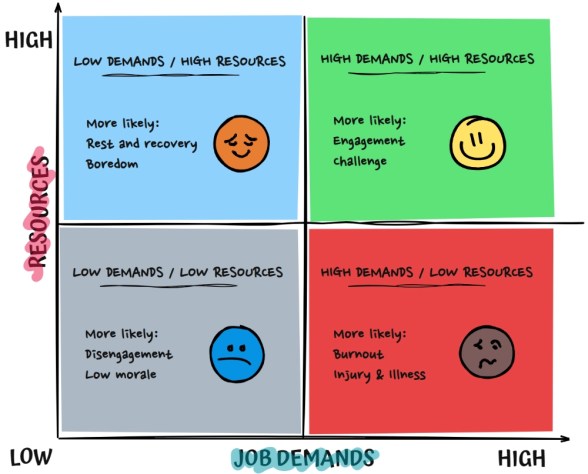
Here’s an expertly drawn and sophisticated infographic that summarises how the interaction works:
A Real-World Example: Policing
I’ve worked with a lot of police over the years, and one thing I often hear from those who’ve been in the job for 20, 30, even 40 years is this: “The job has always been hard – but it was rewarding too. And we used to do a better job of looking after each other.”
Policing is, by nature, a high-demand role. But thirty years ago, many officers described feeling a strong sense of camaraderie, being backed by the organisation, respected by the community, and having autonomy and purpose. These are all examples of job resources.
Fast forward to today, and the demands have only increased – more complexity, more admin, more scrutiny, more pressure. But the resources? In many cases, they’ve gone the other way. Less support. Less connection. Less recognition. Less of that sense of identity and pride.
So now we have a situation where the demands are higher than ever, but the resources that once buffered those demands have eroded. It’s no wonder burnout, psychological distress and mental ill-health are experienced at a concerning rate in frontline policing across the country. Police have gone from the green box in the infographic above, to firmly in the red.
Practical Ways to Apply JD-R in Your Workplace
The JD-R model gives us a roadmap for creating work environments that are both challenging and supportive. It’s not about wrapping everyone in cotton wool – it’s about making sure people have what they need to do their best work without burning out.
Here’s how leaders and organisations can bring JD-R to life in a way that’s both strategic and grounded in the real-world messiness of work.
1. Diagnose the Demands and Resources
Before you can fix anything, you need to understand what’s actually going on. That means going beyond assumptions and gathering real insights from your people. This is what we now call a psychosocial risk assessment.
-
- Ask the right questions: What drains your energy? What helps you do your job well? What would make your work feel more manageable or meaningful?
- Use mixed methods: Combine surveys with focus groups or one-on-one conversations. The numbers will give you patterns; the stories will give you context. (And if you’re wondering how to do this well, then here’s a post prepared earlier!).
- Look at the data: Absenteeism, turnover, complaints, and even productivity metrics can all point to where the pressure points are.
If you need help with this, our Psychosocial Risk Management services are a great place to start.
2. Redesign Roles to Rebalance the Load
Once you’ve mapped out the key demands and resources, it’s time to make some changes.
-
- Reduce unnecessary demands: Streamline red tape, clarify roles, and remove duplicated effort. Not all demands can be eliminated – but many can be softened.
- Boost meaningful resources: Increase autonomy, provide regular feedback, create opportunities for learning and growth, and foster peer support.
- Balance challenge with support: If you’re asking more of people (e.g. new projects, tighter deadlines), make sure you’re also giving them more – whether that’s time, tools, training, or trust.
3. Supportive Leadership is Non-Negotiable
Leadership isn’t just a nice-to-have – it’s a job resource in its own right. And it can make or break how people experience their work.
-
- Train leaders to lead well: Yes, training matters. Just as workplace mental health training helps leaders recognise and respond to psychological risks, leaders also need the skills to listen, coach, give feedback, and spot early signs of burnout.
- But don’t stop at training: Organisations also need to show that they genuinely value supportive leadership. That starts with recruiting and selecting for it – looking for empathy, communication, and people-first thinking, not just technical expertise.
- Give leaders the time and space to lead: If managers are drowning in admin or stretched across too many teams, they won’t have the capacity to support their people. Make sure leadership roles are resourced to be relational, not just operational, and supported through ongoing leadership development.
4. Build Personal Resources Across the Workforce
While job design is key, we can also help people build their own internal toolkit for managing stress and staying engaged.
-
- Offer resilience and wellbeing capability interventions: Think practical, not preachy. Help people build confidence, optimism, and coping strategies.
- Invest in development: Skill-building boosts self-efficacy. So does mentoring, coaching, and giving people stretch opportunities with the right support.
- Support physical wellbeing: Energy is a resource too. Encourage breaks, movement, and recovery – not just in theory, but in practice.
Check out our Workplace Mental Health First Aid or Workplace Training options if you want to get some ideas.
5. Encourage Job Crafting and Autonomy
People aren’t passive recipients of their job descriptions. When given the chance, they’ll often find smart ways to make their work more energising and sustainable. We know that job crafting isn’t an option in every workplace – sometimes there just isn’t a lot of wiggle room to make changes – but where it is possible, find even some small ways to loosen the reins.
-
- Give permission to experiment: Let teams trial new ways of working. If a daily meeting is draining everyone, try a new rhythm. If someone wants to take the lead on a project that excites them, say yes.
- Celebrate initiative: When someone creates a new resource, solves a recurring problem, or supports a colleague, recognise it. These are the micro-moments that build a resource-rich culture.
6. Monitor, Learn, and Adjust
JD-R isn’t a set-and-forget model. It’s a lens you keep coming back to.
-
- Track engagement and stress over time: Use pulse surveys, check-ins, and team reflections to see what’s shifting.
- Listen to the stories: Data is great, but don’t underestimate the power of “It actually feels better now” or “That change made a difference.”
- Tweak as needed: If something’s not working, adjust. If something is working, scale it. Keep the balance dynamic.
Final Thought
There’s no one-size-fits-all solution (except Kaftans – we’ve been clear about how we feel about those) – but the JD-R model gives us a solid foundation. When we balance demands with the right resources, we create workplaces where people don’t just survive – they contribute, connect, and stay well.
And that’s good for everyone. Even Keith.


